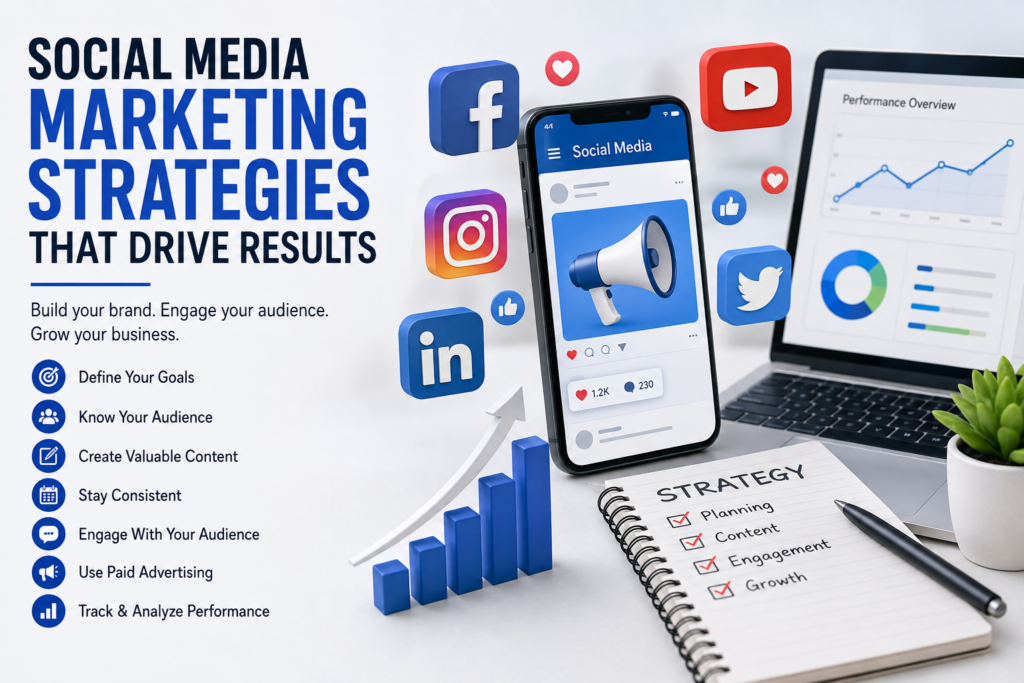
Social media has completely changed the way businesses communicate with their customers. Today, platforms such as Instagram, Facebook, LinkedIn, YouTube, and X are not only used for entertainment or communication. They have become powerful marketing channels that help businesses build brand awareness, connect with potential customers, generate leads, and increase sales.
Millions of people spend a significant amount of time on social media every day. This gives businesses an opportunity to reach their target audience directly and communicate with them in a more personal and engaging way.
However, simply creating a social media account and posting content occasionally is not enough to achieve strong results. Businesses need a clear social media marketing strategy that focuses on audience needs, valuable content, consistent communication, advertising, and regular performance analysis.
A well-planned social media strategy can help businesses stand out from competitors, build customer trust, increase website traffic, and create long-term relationships with their audience.
Why Social Media Marketing Is Important for Businesses
Social media gives businesses the ability to communicate with customers instantly. Unlike traditional advertising methods, social media allows brands to have direct conversations with their audience.
Customers can ask questions, share their opinions, leave reviews, and interact with business content. This type of communication can help businesses understand what customers actually want.
Social media marketing is also useful for businesses of almost every size. A small local business can use Instagram or Facebook to attract nearby customers, while larger companies can use multiple social platforms to reach audiences across different locations.
Another major advantage is that businesses can measure the results of their marketing activities. Social media platforms provide useful data about reach, engagement, clicks, followers, and conversions.
By studying this information, businesses can understand what is working and improve their future marketing efforts.
Effective Social Media Marketing Strategies
1. Start With Clear Marketing Goals
Every successful social media strategy should begin with a clear goal.
Before creating content, businesses should understand what they want to achieve through social media.
Some common social media marketing goals include:
- Increasing brand awareness
- Generating leads
- Increasing website traffic
- Improving customer engagement
- Growing social media followers
- Promoting products or services
- Increasing online or offline sales
- Building customer relationships
Having clear goals makes it easier to plan the right type of content and choose the right social media platforms.
For example, a business focused on brand awareness may create entertaining videos and educational content to reach a larger audience.
On the other hand, a business focused on lead generation may use advertisements, landing pages, contact forms, or direct message campaigns.
Clear goals also make it easier to measure performance and understand whether the marketing strategy is producing meaningful results.
2. Understand Your Target Audience
One of the most important parts of social media marketing is understanding the audience you want to reach.
Businesses should learn about their customers’ interests, age group, location, online behaviour, needs, challenges, and preferences.
Knowing your audience helps you create content that is relevant and useful to them.
For example, if your target audience is mainly young adults, short-form videos, trending content, Instagram Reels, and interactive stories may work well.
If your target audience includes business professionals, LinkedIn articles, industry insights, case studies, and educational posts may be more effective.
Businesses should avoid creating random content without understanding who they are trying to communicate with.
The better you understand your audience, the easier it becomes to create content that attracts attention and encourages engagement.
3. Choose the Right Social Media Platforms
Businesses do not need to be active on every available social media platform.
Instead, they should focus on the platforms where their target audience spends the most time.
Instagram is highly effective for visual content, lifestyle brands, personal branding, short videos, fashion, food, travel, and local businesses.
Facebook can help businesses build communities, promote services, communicate with customers, and run targeted advertising campaigns.
LinkedIn is useful for B2B companies, professionals, agencies, consultants, and businesses that want to connect with decision-makers.
YouTube is an excellent platform for tutorials, product demonstrations, educational videos, reviews, and long-form content.
Selecting the right platforms allows businesses to focus their time and resources more effectively.
4. Create High-Quality and Valuable Content
Content is one of the most important parts of social media marketing.
People are more likely to follow and engage with brands that consistently provide useful, entertaining, or informative content.
Businesses should avoid making every post a direct sales promotion. Instead, they should create a balanced content strategy.
Useful social media content can include:
- Educational tips
- Short-form videos
- Product demonstrations
- Behind-the-scenes content
- Customer testimonials
- Frequently asked questions
- Industry information
- Blog content
- Infographics
- Interactive stories
- Polls and questions
- Offers and promotions
Good content should provide value while also supporting the goals of the business.
For example, a digital marketing agency can share SEO tips, social media ideas, advertising advice, marketing trends, and successful campaign examples.
This type of content can attract potential customers while also demonstrating the knowledge and experience of the business.
5. Use Short-Form Video Content
Short-form video has become one of the most important content formats on social media.
Instagram Reels, YouTube Shorts, and other short video formats can help businesses reach audiences quickly.
Short videos can be used to explain products, share quick tips, show customer experiences, highlight services, or create entertaining brand content.
Videos often feel more personal than static posts because customers can see the people, products, and personality behind the brand.
Businesses should create videos that capture attention quickly and communicate one clear message.
Adding captions, strong opening hooks, clear visuals, and calls to action can help improve video performance.
6. Maintain a Consistent Posting Schedule
Consistency is essential for building a strong social media presence.
Posting regularly helps your audience remember your brand and keeps your business active in their feeds.
However, consistency does not mean posting several times every day.
Businesses should create a posting schedule that they can realistically maintain while keeping content quality high.
Using a content calendar can make this process easier.
A content calendar helps businesses plan upcoming posts, campaigns, videos, events, promotional content, and special occasions in advance.
Planning content can also help maintain variety and prevent repetitive posts.
7. Maintain a Consistent Brand Identity
A recognizable brand identity helps businesses stand out online.
Your social media profiles should maintain consistent colours, fonts, logos, image styles, and communication tone.
When someone sees your content, they should gradually be able to recognize that it belongs to your brand even before seeing your account name.
Consistency builds familiarity, and familiarity can help build trust.
The tone of communication should also remain consistent.
For example, some brands use a professional and informative tone, while others prefer a friendly, casual, and entertaining communication style.
The right style depends on the brand and its target audience.
8. Engage With Your Audience
Social media should not be treated as a one-way communication platform.
Businesses should communicate with followers instead of simply posting content and leaving.
Responding to comments, answering direct messages, reacting to customer posts, and acknowledging feedback can help create stronger customer relationships.
When customers receive quick and helpful responses, they are more likely to develop trust in the business.
Engagement can also encourage more people to interact with future content.
Businesses can create conversations by asking questions, running polls, sharing interactive stories, and requesting customer opinions.
Building a community around your brand can be more valuable than simply increasing follower numbers.
9. Use Calls to Action
A good social media post should often encourage the audience to take the next step.
This is known as a call to action or CTA.
A CTA can encourage users to:
- Visit your website
- Send a direct message
- Contact your business
- Purchase a product
- Book a service
- Read a blog
- Share the post
- Comment on the post
- Follow your account
- Register for an event
Calls to action should be clear and relevant to the content.
For example, after explaining the benefits of a service, the post could encourage users to send a message for more information.
10. Use Paid Social Media Advertising
Organic content is important for building long-term relationships with audiences, but paid advertising can help businesses reach new customers faster.
Platforms such as Facebook, Instagram, and LinkedIn offer advanced advertising tools that allow businesses to target specific groups of people.
Advertisers can target audiences based on factors such as:
- Location
- Age
- Interests
- Online behaviour
- Profession
- Previous website activity
- Previous interactions with the business
Paid campaigns can be used for brand awareness, website traffic, lead generation, product sales, app promotion, and customer retargeting.
Businesses should avoid running ads without a proper strategy.
Successful advertising usually requires a clear objective, attractive creative content, strong copy, accurate targeting, and regular campaign optimization.
11. Use Influencer and Creator Marketing
Influencer marketing can be another effective way to increase brand visibility.
Businesses can collaborate with creators whose audience matches their target customers.
Influencers can promote products, review services, create demonstration videos, or share authentic experiences with a brand.
Businesses do not always need to work with celebrities or influencers with millions of followers.
Micro-influencers with smaller but highly engaged audiences can sometimes produce better results for local businesses and niche brands.
The most important factor is choosing a creator whose audience and content style match the business.
12. Build Trust Through Customer Reviews
Customer reviews and testimonials can strongly influence buying decisions.
People often trust the experiences of existing customers when deciding whether to purchase a product or contact a business.
Businesses can share positive reviews, customer feedback, before-and-after results, case studies, or user-generated content.
This type of social proof can make potential customers feel more confident about choosing the brand.
Businesses should always use genuine customer experiences instead of creating unrealistic or misleading testimonials.
13. Monitor Competitors
Competitor analysis is another useful part of social media marketing.
Businesses can study competitors to understand what type of content they publish, which platforms they use, and how audiences respond.
This does not mean copying their content.
Instead, businesses can use competitor research to identify opportunities and understand what is already working in the industry.
For example, you may discover that competitors are receiving strong engagement from educational videos but are not creating enough detailed guides.
Your brand could use that opportunity to provide more valuable content.
14. Follow Trends Carefully
Social media trends can help brands gain attention when they are used appropriately.
Popular video formats, audio, memes, challenges, or content styles can sometimes help businesses reach new audiences.
However, businesses should not participate in every trend.
The trend should match the brand identity and make sense for the target audience.
Forcing unrelated trends into business content can make a brand look unprofessional or inconsistent.
The best approach is to identify trends that can naturally connect with the business.
15. Track Social Media Performance
Social media marketing should always be measured.
Without tracking performance, businesses may continue creating content without knowing whether it is actually helping them achieve their goals.
Important social media metrics include:
- Reach
- Impressions
- Engagement rate
- Likes
- Comments
- Shares
- Saves
- Follower growth
- Website clicks
- Leads
- Conversions
- Cost per lead
- Sales generated from campaigns
The most important metrics depend on the marketing goal.
For example, a brand awareness campaign may focus on reach and impressions, while a lead generation campaign should focus more on leads, cost per lead, and conversions.
16. Improve Your Strategy Using Data
Social media marketing requires continuous improvement.
Businesses should regularly review their performance and identify which content performs best.
If educational videos receive more engagement than promotional graphics, the business can create more educational videos.
If one advertising campaign generates leads at a lower cost than another, the marketing budget can be adjusted accordingly.
Small improvements based on real data can produce better results over time.
Businesses should experiment with different content formats, posting times, captions, designs, audiences, and advertisements.
Testing helps marketers understand what works best for their specific audience.
Common Social Media Marketing Mistakes to Avoid
Many businesses struggle with social media because they make common mistakes.
One major mistake is focusing only on increasing follower numbers.
Having thousands of followers is not always useful if those followers are not interested in your products or services.
Businesses should focus on building a relevant and engaged audience instead.
Another mistake is posting only promotional content. Constantly asking people to buy something can reduce engagement.
Social media content should provide value and create relationships before expecting customers to make purchases.
Inconsistent posting, ignoring comments, poor-quality visuals, copying competitors, and failing to analyze results can also reduce the effectiveness of social media marketing.
A clear strategy helps businesses avoid these problems.
Organic Social Media vs Paid Social Media
Organic and paid social media marketing both play important roles.
Organic social media includes content that businesses publish without directly paying for distribution.
It helps build brand identity, communicate with existing followers, create communities, and develop customer trust.
Paid social media involves using advertising budgets to reach selected audiences.
Paid campaigns can generate faster visibility and allow businesses to target potential customers more accurately.
Businesses often achieve better results when they combine both approaches.
Organic content can build credibility and relationships, while paid advertising can expand reach and generate new business opportunities.
How Social Media Supports Long-Term Business Growth
Social media should not be viewed only as a platform for quick sales.
A strong social media presence can create long-term value for a business.
Consistent content helps customers remember the brand.
Helpful information can establish authority.
Regular communication can strengthen customer relationships.
Positive reviews can increase trust.
Advertising can attract new customers.
When all these elements work together, social media becomes an important part of the overall digital marketing strategy.
Businesses that focus on building genuine relationships and consistently helping their audience are more likely to achieve sustainable results.
Conclusion
Social media marketing is one of the most powerful tools available to modern businesses, but strong results require much more than simply posting photos or videos.
A successful strategy starts with clear marketing goals and a deep understanding of the target audience. Businesses must choose the right platforms, create valuable content, maintain consistency, interact with customers, use advertising strategically, and regularly analyze performance.
Social media marketing also requires patience.
Businesses may not see major results immediately, but consistent effort and continuous improvement can gradually increase brand awareness, customer trust, leads, and sales.
The most successful brands use social media to create genuine connections rather than simply trying to sell something in every post.
By combining creativity, strategy, communication, and data-driven decision-making, businesses can build a stronger online presence and turn social media into a reliable channel for long-term growth.
Want to grow your business through social media? Get in touch today for professional Social Media Marketing services designed to improve your online visibility, increase engagement, generate quality leads, and support your business growth.